
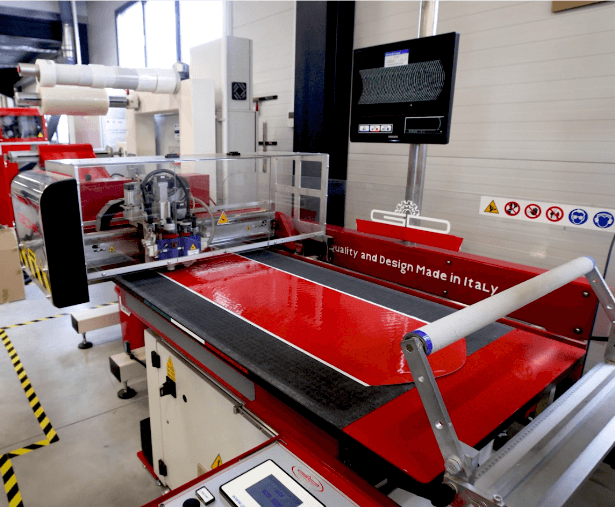
When a custom component is manufactured, its shape and dimensions are determined before machining begins. In practice, however, the dimensions of the finished part may vary slightly from the nominal value. Tolerances are used to define the acceptable limits of these variations.
In the processing of adhesive materials, this aspect becomes relevant when films, foams, tapes, or other adhesive materials need to be transformed into parts with well-defined dimensions and geometries. When specified, tolerances establish the acceptable dimensional limits and provide a benchmark for the production and inspection of parts.
At MDE Converting, each project is analyzed based on the component to be produced. The material, configuration, and dimensional requirements are taken into account to determine the appropriate processing method. The possibilities can vary from one project to another, which is why precision must be tailored to the specific characteristics of each application.
The same tolerance is not suitable for every part
Tolerance indicates the limits within which a particular dimension may vary from the value specified in the design. However, this does not mean that all components must be manufactured to the same specifications. A part with simple geometry may have different specifications than one with a complex contour, holes, or other features that must be manufactured within well-defined dimensional limits.
The role that the component will play in the product is also important. For certain applications, some dimensions may be more critical for the part’s integration, while other characteristics may allow for different variations. The requirements must therefore be defined in relation to the specific component.
Information that may be relevant when determining dimensional specifications includes:
- Overall dimensions of the part
- Shape and complexity of the outline
- The presence of holes or cutouts
- The position of certain elements within the component
- How the part will be integrated into the final product
The material and geometry of the part can affect machining
The materials used in conversion can have very different properties. A thin film does not necessarily behave the same way as a foam, and a multilayer structure may have different processing characteristics than a material with a simpler structure.
Thickness, flexibility, and structure are just a few of the characteristics that may be relevant. How these characteristics affect machining depends on the specific material and the part to be produced. For this reason, dimensional requirements should not be analyzed separately from the material’s properties.
Geometry, in turn, introduces additional factors that must be taken into account. The contours, cutouts, dimensions, and other characteristics of the part can influence how the material is processed. The same shape made from materials with different properties may require different approaches, which is why each combination of material and part configuration must be analyzed within the context of the project.
The cutting process is chosen based on the part to be produced
Once the part specifications and the material to be processed are known, the appropriate conversion method can be determined. There are several technologies that can be used to transform flexible materials into components, and each has its own characteristics and applications.
Stamping can be used to produce shapes and cutouts from suitable materials, while laser processing is another option for certain applications and geometries. The choice between different methods should not be reduced to the idea that one is always more precise than the other. The material, the shape of the part, and the project requirements must be considered together.
Before processing begins, several types of information may be relevant:
- Technical drawing of the component
- Specified tolerances
- The material to be processed
- Thickness and structure of the material
- The final geometry of the part
Accuracy is based on the actual requirements of the part
In our field, precision does not mean achieving theoretically perfect dimensions without any variation. What is more important is that the parts comply with the specifications and dimensional limits established for the specific application.
Dimensional requirements become truly useful when they are defined in relation to the component’s function and configuration. In this way, the focus is not on achieving the smallest possible deviation in every situation, but on adhering to the limits relevant to the design.
Working with a specialized converter allows for the analysis of dimensional requirements in conjunction with the material and the available machining options. In this way, tolerances can be evaluated in the specific context of the component and the process by which it will be manufactured.



 EN
EN  RO
RO  DE
DE