
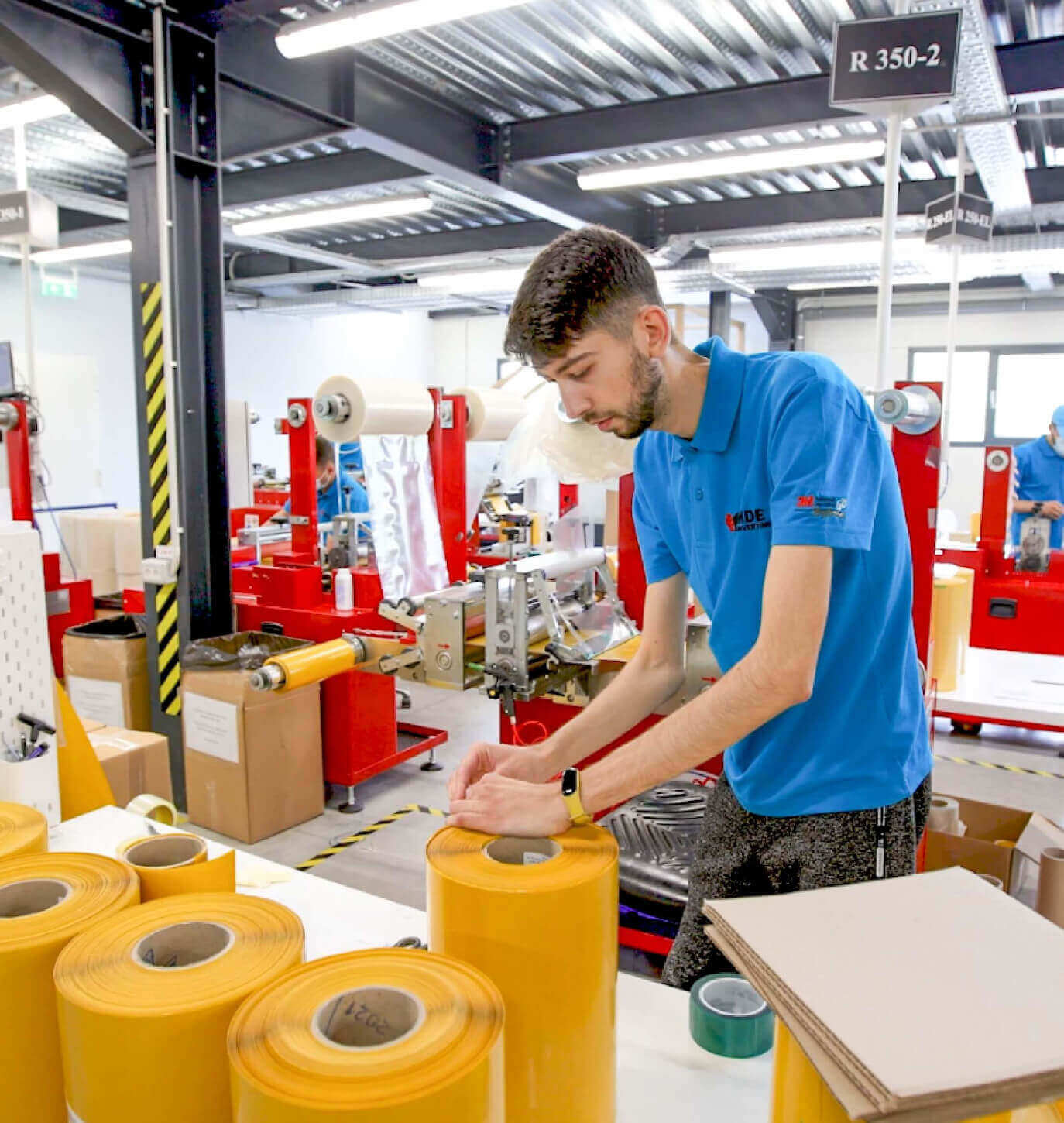
In manufacturing, certain stages are automated to increase efficiency, reduce processing times and variations, and maintain a consistent level of quality. These may include operations such as part handling, positioning, assembly, inspection, or final packaging. In many industries, such processes help establish a steady workflow.
Production lines operate according to well-defined parameters. All components must be positioned precisely, the operating speed must remain constant, and operations must not involve any variations. The efficiency of the entire process can be compromised if there are issues in this regard.
Technical solutions developed through the conversion of adhesive materials help companies facing such challenges. The components we produce can meet the specific requirements of automated operations. At MDE Converting, we can develop solutions that can be used effectively over the long term.
The precision of parts matters in automated processes
In these types of processes, each stage is configured for a specific operating rhythm and precise positioning of components. The equipment operates based on predefined parameters. As a result, any deviation can affect the final result to some extent.
Variations can affect how a component is mounted or integrated into a technical assembly. If not done properly, there is a risk of positioning errors, sudden stoppages, and even the need for frequent line interventions. To maintain productivity and quality, repeatability is essential.
In many industrial processes, stability depends on both the performance of the equipment and the reliability of the components used in the workflow. Through controlled conversion processes, parts can be produced that ensure the consistent operation of the production line.
The components produced can contribute to:
- Compliance with the required tolerances
- Proper positioning during installation
- Reducing errors caused by dimensional variations
- Easy integration into the automated workflow
Materials specific to the intended use
Other important factors include the geometry of the parts used and how the material behaves during handling. An effective component must be easy to handle and position correctly in every cycle. If the material is not suitable, difficulties may arise as early as the assembly stage.
Sometimes, parts are more difficult to handle at very high speeds; other times, they may require additional adjustments. At the same time, they can react differently depending on environmental conditions and the stresses to which they are exposed. For this reason, material selection plays a crucial role in ensuring process efficiency and the predictable behavior of the final part.
During the selection process, various aspects are frequently reviewed:
- Material properties and stability
- Compatibility with existing surfaces
- Resistance to operating conditions
Some applications require high adhesion, others require effective sealing and vibration damping, and there are also projects that require insulation. The right material contributes both to the efficiency of the installation and to the performance of the part after application.
A well-designed component simplifies the entire workflow
The efficiency of a process depends not only on speed, but also on how easily all the components can be integrated. When designed correctly, operators do not need to intervene to make adjustments, and the workflow can be kept stable.
The part’s shape, contact area, and dimensions influence how it is used in production. The delivery format is also important, as is compatibility with existing equipment. In repetitive processes, all of these details can have a direct impact on the pace of work.
Our approach to streamlining these operations is based on a detailed analysis of the project requirements. Depending on the project’s scope, we can design a solution that meets both technical and operational needs. With the right approach, we can deliver numerous long-term benefits to our partners.
Automation enabled by the right solutions
Modern industrial operations require precise, reliable solutions that integrate seamlessly exactly where they are needed. When every component is designed to meet the actual requirements of the process, production runs more smoothly and results become more predictable.
Our team develops customized technical solutions tailored to modern manufacturing processes and beyond. We pay close attention to material selection, use the right cutting technologies, and refine parts to ensure they are in optimal condition for use. This approach helps us support companies seeking sustainable performance.

 EN
EN  RO
RO  DE
DE