
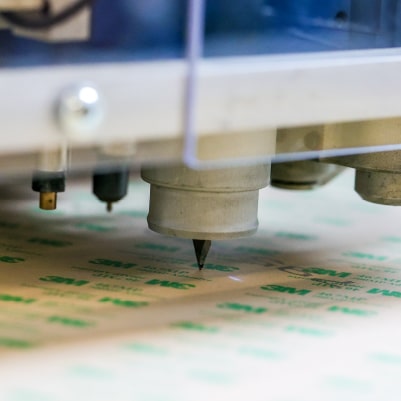
Before a custom component goes into production, the proposed design can be evaluated against the project requirements. Producing a prototype provides an opportunity to examine the finished part and identify any necessary modifications before proceeding further in the process.
When selecting adhesive materials, this step can involve several factors. The component’s design, its intended use, and the chosen material must all be considered together. Requirements vary from one application to another, which is why the same solution cannot be considered suitable for every project.
At MDE Converting, our partners can request samples to test different materials and configurations. Our team processes various types of tapes, foams, and protective films using a range of conversion processes. This allows us to develop components tailored to the specifications of the project we are working on.
The shape and configuration of the part
The geometry of a component is determined based on the application’s requirements. Some parts have simple shapes, while others may include complex contours, holes, cutouts, or other design-defined elements. Before production, the prototype can be compared to the specifications established for the final part.
The configuration can become more complex when a component is made of multiple materials. Depending on the project, lamination can be used to combine compatible layers, and the resulting material can then be machined into the required shape. Lamination and cutting processes are part of our technical capabilities.
In order for the developed solution to be properly analyzed, the information provided must describe the desired component as clearly as possible. Depending on the project, this may include:
- The purpose for which the solution is created
- Required materials and construction
- Specific requirements for certain areas of the piece
- Changes made after a prototype was built
- Other technical information relevant to processing
The overall integration process
A component is not used separately from the product for which it was designed. Its position within the assembly and its relationship to nearby elements may impose additional requirements beyond those observed when the part is analyzed individually.
The available space may affect the required outline, and certain product features may require the inclusion of open areas or cutouts. For surfaces with unique geometries, the part’s configuration must be adapted to the area where it will be positioned.
It also matters how the component will be used in the next stage. For an adhesive part with a liner, for example, there may be requirements regarding access to the liner before application. These considerations are not the same for all projects and should be analyzed only when they are relevant to the component in question.
At this stage, issues that do not directly concern the geometric characteristics already established can also be clarified:
- Procedure for receiving and handling the component
- How to remove the liner, if included
- The order in which the components should be integrated
- The format in which the piece must be submitted to advance to the next round
Type of material used
The choice of material must be made based on the application. Adhesive tapes, foams, films, and other technical materials have different properties, and a material suitable for one project is not automatically suitable for another. MDE states that it can recommend material options based on the application and can send samples to customers for testing.
When it comes to adhesives, the surfaces to which they will be applied are an important consideration. Plastics, metals, glass, and other substrates can have different characteristics. Surface finishes or treatments can, in turn, introduce additional requirements that must be taken into account when selecting the adhesive.
The conditions of use may also be relevant. Depending on the application, there may be requirements regarding temperature, humidity, mechanical stresses, or other factors affecting the product. These must be analyzed on a case-by-case basis, without assuming that the same criteria apply to all projects.
An important step toward a high-quality product
Pre-production checks can help clarify important aspects of the component. The shape and configuration can be compared to the design specifications, the integration can be analyzed in the context of the product, and the material can be evaluated based on the application’s requirements.
These elements are interrelated. A change in the material can alter the machining conditions, while adjusting the configuration can impose different requirements for the part’s manufacture. For this reason, the final component must be viewed as a set of characteristics that must be compatible with the design.



 EN
EN  RO
RO  DE
DE